
How wastewater innovation helped shape modern-day America As America approaches its 250th Independence Day, most conversations about progress focus on transportation, manufacturing, medicine, or technology. Those stand out, are visible, and are clear beacons of advancement in our country. But one of the greatest drivers of America’s growth happened underground. The evolution of wastewater infrastructure […]
How wastewater innovation helped shape modern-day America
As America approaches its 250th Independence Day, most conversations about progress focus on transportation, manufacturing, medicine, or technology. Those stand out, are visible, and are clear beacons of advancement in our country.
But one of the greatest drivers of America’s growth happened underground.
The evolution of wastewater infrastructure fundamentally changed what American cities, industries, and communities were capable of becoming.
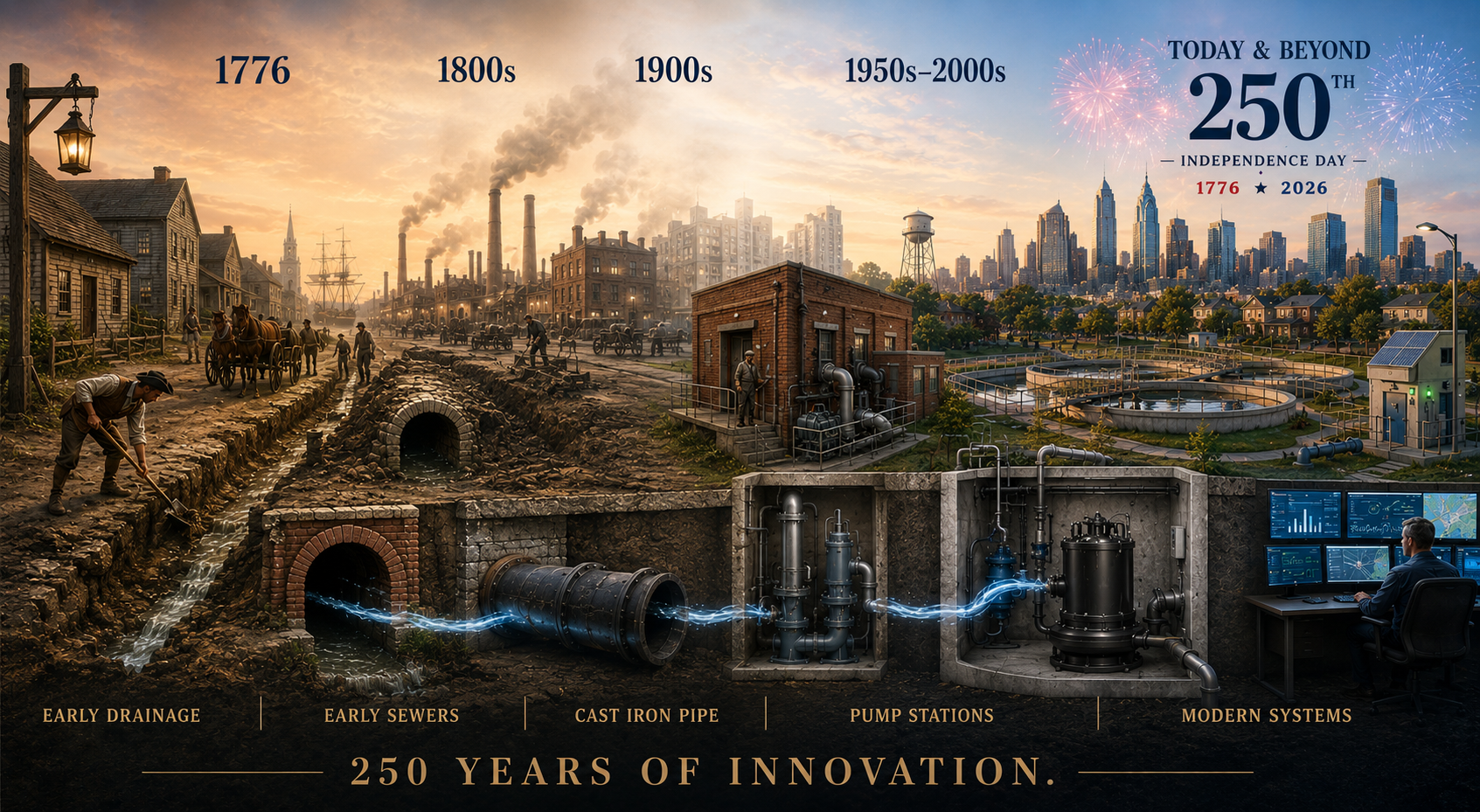
In 1776, sanitation systems were extremely localized and primitive. Communities relied on outhouses, privies, drainage ditches, cesspools, or direct disposal into nearby waterways. Stormwater and sewage were often unmanaged. Waste removal was labor-intensive, inconsistent, and heavily dependent on geography and population density.
That worked because that is what was available. But it wasn’t sustainable. As explorers and settlers headed west to establish new communities, it was clear that something had to change.
As industrialization accelerated in the 1800s, population density exploded in urban areas. Suddenly, wastewater was a real problem. It became a public health crisis. Cholera outbreaks, contaminated drinking water, flooding, and disease forced cities to rethink infrastructure entirely.
The solution was decades of innovation. So many things had to change, and then change again. Innovation became the rule.
Gravity sewer systems became more organized and engineered. Municipal pumping stations allowed wastewater to move uphill and across longer distances. Cast iron piping improved durability and reliability. Treatment plants evolved from basic discharge systems into sophisticated multi-stage treatment operations.
Then came some of the most transformative wastewater innovations of the 20th century.
Submersible pumps dramatically improved efficiency and safety compared to earlier dry-pit systems. Lift stations allowed expanding suburbs and developments to grow in areas that previously could not support centralized sewer access. Grinder pumps and solids-handling pumps helped move increasingly difficult waste streams more reliably through municipal systems.
Advancements in impeller design reduced clogging and improved hydraulic efficiency. Variable frequency drives (VFDs) allowed smarter pump control and energy savings. SCADA monitoring systems gave municipalities remote visibility into system performance, alarms, flow rates, and failures in real time.
These were not small improvements.
They changed what American communities could become.
Modern wastewater infrastructure made dense urban development safer. It supported hospitals, manufacturing plants, schools, stadiums, airports, food production facilities, and expanding residential communities. It improved environmental protection and dramatically reduced waterborne disease. It allowed American industry to scale.
And the work continues today.
One of the biggest modern challenges facing wastewater systems is something engineers from previous generations never anticipated. How could they know then what we’d be flushing into our systems now.
Modern sewer systems encounter wipes, rags, towels, clothing materials, plastics, hygiene products, grease buildup, and other dense solids that older systems were never originally designed to process. Those materials create clogging, downtime, pump failures, overflow risks, and expensive maintenance challenges for municipalities and operators across the country.
That challenge has driven one of the industry’s more important modern innovations: advanced pulverizing technology.
At Keen Pump, the development of the Pulverizer Pump represents exactly the kind of innovation the wastewater industry continues to need as America moves into its next century of infrastructure growth.
Unlike traditional grinder pumps designed for lighter-duty applications, the Pulverizer was engineered to process some of the toughest solids found in modern wastewater streams, grinding thick, fibrous, and difficult materials into a slurry that can move more reliably through municipal systems without clogging and can pump the materials further away from growing communities.
That matters because wastewater systems today operate under far different conditions than they did decades ago. Higher population density, heavier solids loading, aging infrastructure, and increasing operational demands require tougher, more adaptable equipment solutions.
Innovations like advanced grinder technology help municipalities reduce clogs, minimize downtime, improve reliability, and extend the life of broader wastewater infrastructure systems already under strain.
So, what about the next 250 years? Just like our founding fathers before us, it’s hard to know what the future will bring. But we can plan for success.
America’s next generation of wastewater infrastructure will likely include smarter monitoring systems, predictive maintenance technology, energy-efficient pumping systems, advanced retrofit solutions, AI-assisted diagnostics, and increasingly resilient infrastructure designed to adapt to changing environmental and operational conditions.
In many ways, the wastewater industry mirrors America itself.
Problem-solving. Innovation. Adaptation. Growth.
And as our nation celebrates 250 years of independence, everyone at Keen Pump is proud to continue contributing to that story as an American company.
We are proud to support the municipalities, contractors, engineers, distributors, and operators who help keep America running every day. And we are proud to be part of an industry that continues improving the quality of life for future generations.
This country was built by people willing to solve problems, build infrastructure, and create something better for those who came next.
That spirit is still alive today.
God Bless America! Here at Keen Pump, we believe that He has, and that He will.